

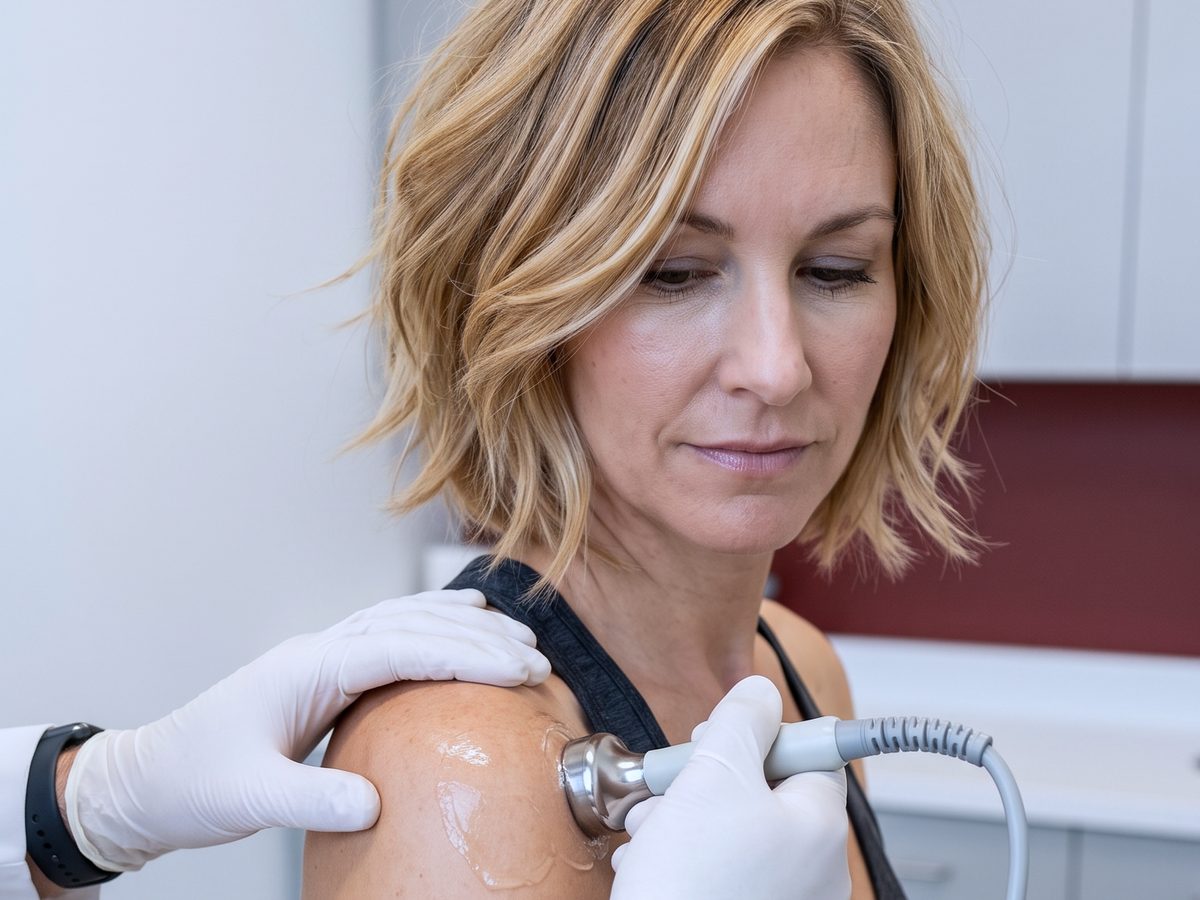
Extracorporeal shockwave therapy (ESWT) is a non-invasive treatment that applies acoustic pressure waves through the skin to painful tendons, muscles and soft tissue. Common applications in Doral, FL include plantar fasciitis, tennis/golfer's elbow, and chronic tendinopathies. Chronic plantar fasciitis is the most studied ESWT indication in the peer-reviewed NIH/PMC literature; reviews report benefit for some patients when conservative therapy has failed, and results vary. Each session lasts about 4–10 minutes, no anesthesia is needed, and most patients return to normal activity the same day. According to the American Orthopaedic Foot & Ankle Society, plantar fasciitis affects roughly 1 in 10 U.S. adults over a lifetime (2022 estimate), and it is the single most common reason patients come to our Doral clinic asking about shockwave. At Viva Centers, our bilingual physicians review your prior treatments, imaging, and activity goals before recommending an ESWT course — and we are honest about which conditions are well studied and which are not. Results vary, and not everyone is a candidate — if you are not, we tell you.
Conditions Commonly Treated with Shockwave Therapy
Chronic plantar fasciitis is the most studied ESWT indication, alongside several tendinopathies that have failed conservative therapy. Per AAOS patient guidance and NIH/PMC systematic reviews, the conditions below typically warrant a shockwave consultation when 6+ weeks of conservative care has not resolved pain:
- Plantar fasciitis and chronic heel pain — the most common and best-studied ESWT indication
- Achilles tendinopathy — chronic inflammation and degeneration of the Achilles tendon
- Tennis elbow (lateral epicondylitis) and golfer's elbow (medial epicondylitis)
- Rotator cuff tendinopathy and calcific shoulder tendinitis
- Patellar tendinopathy (jumper's knee)
- Greater trochanteric pain syndrome (hip bursitis)
- Myofascial trigger points and chronic muscle tension
- Medial tibial stress syndrome (shin splints)
- Morton's neuroma and other chronic forefoot pain
How Shockwave Therapy Works — And What Is Still Unknown
Shockwave therapy delivers controlled acoustic pressure waves through the skin into the painful tendon or fascia. Being straight with you: the exact biological mechanism is not settled science. CMS's own coverage determination states the therapeutic mechanism "is not completely known," and the UK's NICE describes it the same way. Researchers have proposed several explanations — changes in local blood flow, effects on tissue remodeling, and interference with pain signaling — but these remain proposed, not proven. What is documented is more practical:
- It is delivered through the skin — no incision, no injection, no anesthesia
- A session takes about 4–10 minutes, and you walk out the same day
- A typical course is 3–6 weekly sessions rather than a single visit
- When it helps, improvement usually develops over 4–12 weeks, not overnight
- It is used for calcific tendinitis, where calcium deposits are visible on imaging
- It does not work for everyone — candidacy is decided at the evaluation, not in advance
What Does Shockwave Therapy Feel Like?
This is the most common question patients ask before their first visit. Honest answer:
- The handpiece sits against your skin with a thin layer of ultrasound gel
- Each pulse feels like a rapid mechanical tap or knock — sharper than ultrasound but not a needle stick
- On a tender plantar fascia or tennis-elbow tendon, the first 30–60 seconds are typically the most uncomfortable, then your body acclimates
- Discomfort is rated 3–6 out of 10 by most patients during treatment, and the intensity is dialed up gradually so you control it
- No anesthesia is needed — patients drive themselves home
- Some patients feel mildly tender or bruised in the treated area for 24–48 hours; tell us about anything beyond mild soreness so we can reassess
Session Sequence — What to Expect Over a Treatment Course
A typical ESWT course at our Doral clinic is structured as follows:
- Initial consultation — exam, review of prior treatments and imaging, confirmation of candidacy
- Insurance check + written cost estimate before any treatment (most ESWT is self-pay or partially covered)
- Session 1 (week 1) — orient you to the device, find tender points, deliver a calibrated first treatment of 4–6 minutes
- Sessions 2–4 (weeks 2–4) — weekly treatments with intensity titrated up as tolerance builds
- Sessions 5–6 (weeks 5–6) — final treatments in the initial course; we assess progress
- Reassessment at week 8–12 — when improvement occurs, it usually develops 4–12 weeks after the final session
- Coordination with physical therapy, footwear changes, and load-management advice for long-term results
ESWT vs. Physical Therapy and Other Options
ESWT is not a replacement for physical therapy — it works best as a complement. Here is how the options typically stack up for the most common indication, plantar fasciitis:
- Conservative care first: stretching, supportive footwear, night splints, weight management, and activity modification work for most patients within 6 weeks
- Physical therapy: addresses the kinetic chain — calf flexibility, foot intrinsic strength, gait mechanics
- ESWT: considered when 6+ weeks of conservative care has not resolved pain; chronic plantar fasciitis is its most studied use
- Corticosteroid injection: short-term relief but with a small risk of plantar fascia rupture; not a long-term solution
- Surgery (plantar fascia release): reserved for cases that have failed all of the above — rarely needed when ESWT is offered earlier
- We build a stepwise plan with you rather than jumping to the most aggressive option
Who Is a Good Candidate for Shockwave Therapy
Best evidence supports ESWT in patients with the following profile:
- Chronic tendon or fascia pain lasting more than 6 weeks despite rest, stretching, and conservative care
- Failed first-line treatments — physical therapy, footwear changes, NSAIDs
- Athletes and active adults with overuse injuries — plantar fasciitis, Achilles tendinopathy, jumper's knee
- Adults with calcific tendinitis or chronic bursitis confirmed on imaging
- Patients seeking a non-surgical alternative before considering injection or surgical options
- Bilingual English/Spanish consultations are available — most of our Doral patients prefer Spanish-first visits
Authoritative Resources and Clinical Guidance
Sources
- AAOS OrthoInfo — Patient information library — American Academy of Orthopaedic Surgeons
- NIH/PMC — Systematic review of ESWT for plantar fasciitis — U.S. National Library of Medicine
- CMS Medicare Coverage Database — Centers for Medicare & Medicaid Services
Frequently Asked Questions
What is shockwave therapy (ESWT) and how does it work?
Extracorporeal shockwave therapy (ESWT) is a non-invasive treatment that delivers acoustic pressure waves to injured tissue. The exact biological mechanism is not settled — CMS's coverage determination states it "is not completely known" and NICE describes it the same way — so we do not claim to know how it works at the cellular level. Originally developed in the 1980s for kidney stone treatment, ESWT is now widely used in orthopedic and sports medicine for chronic tendon and fascia conditions — most notably plantar fasciitis. Per AAOS and NIH/PMC literature, it is most appropriate when conservative care has not resolved pain after 6 or more weeks.
Does shockwave therapy hurt?
Most patients describe the sensation as a rapid mechanical tapping with mild-to-moderate discomfort, rated about 3–6 out of 10 during treatment. The intensity is adjusted in real time to your tolerance. Each session lasts 4–10 minutes and any soreness afterward typically resolves within 24–48 hours. No anesthesia is needed and patients drive themselves home. The first 30–60 seconds on a tender area are usually the most uncomfortable; once your tissue acclimates, the rest of the session is much easier.
How many shockwave therapy sessions do I need?
A typical course is 3–6 weekly sessions for most conditions. Plantar fasciitis and tendinopathies are commonly treated with a 5–6 session course; smaller indications are sometimes planned for 3. Your physician evaluates progress between visits and may extend or shorten the plan. When improvement happens, it often develops 4–12 weeks after the final session — so it is normal to feel only modest change while still in the treatment course, and some patients do not improve.
What conditions does shockwave therapy treat?
ESWT is most studied for chronic plantar fasciitis, Achilles tendinopathy, lateral epicondylitis (tennis elbow), medial epicondylitis (golfer's elbow), rotator cuff tendinopathy, calcific shoulder tendinitis, and patellar tendinopathy (jumper's knee). It is also used for greater trochanteric pain syndrome, myofascial trigger points, shin splints, and Morton's neuroma. It is generally considered only for chronic conditions that have not responded to 6+ weeks of conservative care, and results vary.
Is shockwave therapy covered by insurance?
Coverage varies widely. Some Medicare and commercial plans cover ESWT for specific diagnoses such as chronic plantar fasciitis after conservative therapy has failed; many plans still classify ESWT as investigational and do not cover it. Coverage depends on your specific plan and on the Medicare contractor rules that apply in Florida; ESWT for musculoskeletal conditions is frequently not covered. Our team checks your plan and provides a written estimate before the first treatment so you can make an informed decision. Call +1 305 209 0001 for a benefits check.
How much does shockwave therapy cost in Miami?
When insurance does not cover ESWT, patients in Doral pay per session or per package. Price depends on the body area, whether radial or focused shockwave is used, and how many sessions the physician recommends. We do not quote a course price before the evaluation, because the number of sessions is a clinical decision — but you receive a written estimate before any treatment begins, and we run promotional package pricing at times during the year. Call +1 305 209 0001 for current rates.
What does ESWT feel like during the treatment?
The handpiece is placed against your skin with ultrasound gel. Each pulse feels like a fast mechanical tap — sharper than a deep-tissue massage but not painful enough to require anesthesia. The intensity is dialed up gradually so you stay in control. Most patients feel mild residual tenderness for 24–48 hours afterward, and we ask that you tell us about anything beyond mild soreness. If you experience anything beyond mild soreness, let us know and we adjust intensity at the next session.
How is shockwave therapy different from physical therapy?
ESWT and physical therapy work best together, not in competition. Physical therapy addresses biomechanics — calf flexibility, foot intrinsic strength, gait, and loading mechanics that caused the injury. ESWT is applied to the painful tendon or fascia itself. For chronic plantar fasciitis, physicians commonly combine stretching and load management with a 4–6 session ESWT course, rather than relying on either alone. We coordinate referrals to physical therapy when indicated.
Are there side effects or contraindications for shockwave therapy?
Common temporary effects include mild soreness, swelling, redness, and occasional small bruises at the treatment site lasting 24–48 hours. ESWT is contraindicated for patients with blood-clotting disorders or on therapeutic anticoagulation, active infection at the treatment site, pregnancy, pacemakers, growth plates in skeletally immature patients, and tumors in the treatment area. Your physician reviews your complete medical history before the first session. Bilingual English/Spanish consultations are available — call +1 305 209 0001 to schedule.